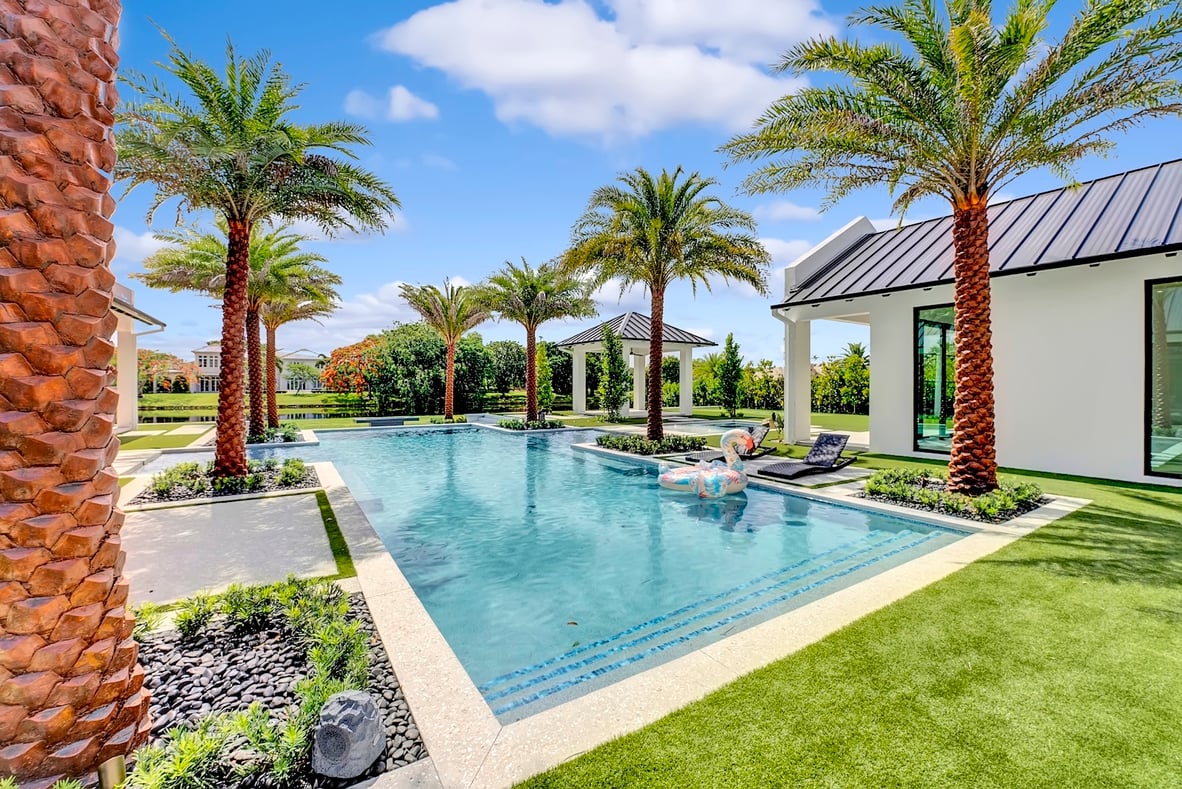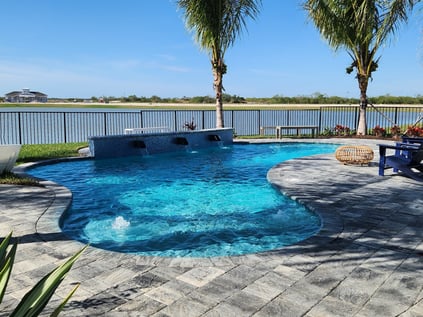
Picture a Saturday afternoon in your backyard. The kids are racing through arcs of water from the deck jets, a sheet of water spills into the deep end, and a bubbler hums on the tanning ledge while you settle in with something cold. Pool water features are what turn a nice pool into the one everybody remembers after the party.
Choosing them well takes a little South Florida know-how. Our heat, our long swim season, and our summer storms all affect how a feature looks, sounds, and holds up.
What Are Pool Water Features?
Pool water features are fixtures that move water above, across, or into your pool for sound, looks, or play, like waterfalls, deck jets, bubblers, and scuppers. Most run off your pool's circulation system, either through the main pump or a pump of their own. You can build them into a new pool, and in many cases, you can add them to the pool you already have.
What Types of Pool Water Features Are There?
The most common swimming pool water features fall into seven groups. Many backyards combine two or three, like a sheer descent paired with deck jets.
|
Feature |
What it does |
Best for |
Where it goes |
|---|---|---|---|
|
Rock waterfall |
Water tumbles over natural or cast stone |
Tropical, resort-style backyards |
Raised rockwork at the pool edge |
|
Sheer descent or rain curtain |
A smooth sheet or thin streams of water fall into the pool |
Clean, modern designs |
Raised wall or overhead structure |
|
Deck jets and laminars |
Arcs of water shoot from the deck into the pool |
Kids, play, nighttime light shows |
Pool deck |
|
Bubbler |
Water bubbles up from just below the surface |
Tanning ledges and shallow areas |
Ledge or steps |
|
Scupper or water bowl |
Water pours from a spout or spills over a raised bowl |
Architectural looks, evening ambiance |
Raised wall or pool edge |
|
Spillover spa |
Spa water spills over the edge into the pool |
Pool and spa combinations |
Raised spa |
|
Fountain |
Water sprays up or out from a nozzle or statue |
Classic, formal designs |
In the pool or at its edge |
Rock Waterfalls
A rock waterfall sends water tumbling over stacked natural or cast stone into the pool. It's the classic tropical look, and it brings the most sound of any feature, which is great for drowning out a busy street. Big waterfalls need serious water flow, so they're usually the feature that shapes your pump and plumbing plan.
Sheer Descents and Rain Curtains
A sheer descent releases a smooth, glassy sheet of water from a slot in a raised wall. It's quieter than a waterfall and fits modern and rectangular designs well. A rain curtain drops thin streams of water from an overhead bar or pergola, and it's a great spot to cool off on a 95-degree afternoon.
Deck Jets and Laminars
Deck jets are small nozzles set into the pool deck that shoot arcs of water into the pool. Laminars are a sleeker version that produce a smooth, rod-like stream, often lit with LEDs for a nighttime show. Kids love jumping through them, so make sure the arcs land where swimmers won't get hit at close range.
Bubblers
A bubbler pushes a column of water up from just under the surface, usually on a tanning ledge or wide step. They're gentle, quiet, and a favorite with little kids and dogs. If you're planning a tanning ledge for your pool, a bubbler or two is the most natural pairing.
Scuppers and Water Bowls
Scuppers are spouts set into a raised wall that pour a steady stream into the pool. Water bowls sit on a wall or the pool edge and overflow into the water below. A fire-and-water bowl adds a gas flame on top, which makes a big impression after sunset, though it also needs a gas line in your plan.
Spillover Spas
A spillover spa is a raised spa whose water flows over one edge into the pool. You get the gentle sound of moving water every time the spa runs, and the two read as a single design rather than two separate pieces.
Fountains
A pool fountain sprays water up or out from a nozzle, a statue, or a decorative spout. Options range from small floating units that screw onto a return jet to built-in sculptural pieces that anchor a formal design.
How Do Water Features Hold Up in South Florida?
Water features hold up well in South Florida when you plan for the heat, mineral buildup, and storm season. These three matter more here than in most of the country.
Evaporation
Moving water evaporates faster than still water, and South Florida's heat already pulls a steady amount out of every uncovered pool. Running features when you're actually out enjoying them keeps that loss under control.
Calcium and Salt Buildup
Every time water evaporates, it leaves its minerals behind. Over time, white scale can build up on nozzles, scupper lips, and waterfall stone, and saltwater pools add their own deposits. Balanced water chemistry and a quick scrub of nozzles and edges keep the streams clean and even.
Storm-Season Debris
Summer storms and hurricane season blow leaves, sand, and palm fronds into the pool. The small nozzles on deck jets and laminars clog easily, so give them a quick check after a storm. Before a big one, shut your features off and clear loose items from the deck.
Do Water Features Raise Your Energy Bill?
Water features can increase your energy costs, mainly because waterfalls and sheer descents require more flow than everyday filtration. How much they add depends on your pump and how long the features run. ENERGY STAR estimates that a pool pump can cost up to $310 a year in electricity, and that certified variable-speed pumps use about 60% less energy than old single-speed models, according to its pool pump fact sheet.
Florida requires residential filtration pumps to meet the state's energy efficiency code under Florida Statute 553.909. Every new Fountain Blue pool comes with a variable-speed pump, and that works in your favor here. The pump filters quietly at low speed most of the day, then ramps up when you turn the waterfall on. An automation system lets you schedule features or start them from your phone, and larger features sometimes get a dedicated pump of their own.
What Electrical Safety Rules Apply to Lit Water Features?
Any water feature with lights, a dedicated pump, or a fire element connects to your home's electrical system, and that work has to meet code. Pool bonding rules in Florida, based on the National Electrical Code, connect metal parts in and around the pool "to reduce voltage gradients in the pool area," as the Florida Building Commission puts it.
Pool circuits also need ground-fault circuit interrupters (GFCIs), which cut power the moment they sense current leaking where it shouldn't. The U.S. Consumer Product Safety Commission recommends testing GFCIs monthly. Lit laminars, LED bubblers, and fire bowls should always be installed by a licensed contractor under permit.
Why Plan Water Features Before Your Gunite Pool Is Built?
Planning features before construction is the most straightforward way to get them. In a gunite pool, the plumbing lines, light niches, and bubbler fittings go in before the shell is sprayed, so they're built right into the concrete. Raised walls for sheer descents, scuppers, and water bowls are formed at the same time.
Construction typically runs 6–8 months from contract to swimming, and the design phase at the start is the time to make these calls. At Fountain Blue, our custom pool design process includes 3D renderings, so you can see exactly where the waterfall lands and how the deck jets arc before anyone breaks ground.
Can You Add a Water Feature to an Existing Pool?
Yes, most existing pools can take a water feature. The work involved depends on the type.
- Plug-in features: floating fountains and spray attachments screw onto a return jet with no construction at all.
- Plumbed features: deck jets, sheer descents, waterfalls, and bubblers need new plumbing lines, which usually means cutting into the deck and sometimes adding a pump.
The best time to add a plumbed feature is during a pool remodel, when the deck, tile, or surface is already being opened up. You do the messy part once and come out with a pool that feels new.
How Do You Choose the Right Water Features for Your Backyard?
Start with how you'll use the pool, then pick features that fit that picture. A pool built for the kids calls for very different features than one built for evening entertaining.
- For sound and relaxation: a rock waterfall, sheer descent, or spillover spa
- For kids and play: deck jets, bubblers, or a rain curtain
- For a modern, architectural look: sheer descents, scuppers, and laminars
- For evenings and entertaining: lit laminars and fire-and-water bowls
- For a tanning ledge: bubblers
Think about sound, too. A big waterfall near a bedroom window can be a lot at night, while a sheer descent stays soft. Scrolling through real Fountain Blue projects in the pool gallery is a good way to see how different features look in a South Florida backyard.
Pool Water Features FAQ
Are pool water features worth it?
For most South Florida pool owners, yes, because the pool gets used nearly year-round. A feature you see and hear every day adds to how much you enjoy the space. Choose features that match how you actually use the pool, and plan for a little more water and energy use.
Do water features increase evaporation?
Yes, moving water evaporates faster than still water. Waterfalls, jets, and sprays add surface movement and splash, so you'll top off the pool more often. Running them on a schedule and covering a spa when it's not in use helps.
How much do pool water features cost?
The cost depends on the type of feature, its size, and whether it's built in during construction or added later. A plug-in fountain is a small purchase, while a custom waterfall or sheer descent wall involves masonry, plumbing, and sometimes a dedicated pump. A design consultation is the best way to get pricing for your specific pool.
Can water features run with a variable-speed pump?
Yes, and variable-speed pumps are a good match for them. The pump handles low-speed filtration and ramps up only when your features are running. Pool automation lets you schedule them around your day.
How much maintenance do pool water features need?
Most need light, regular care: clearing debris, cleaning scale from nozzles and edges, and keeping the water balanced. Weekly pool service typically covers these tasks along with the rest of your pool.
Bring Your Backyard to Life
Fountain Blue Pools has been designing custom gunite pools from Parkland to Port St. Lucie since 1996. Stop by our West Palm Beach showroom or call 561-971-0504 to start your design. We'll show you your waterfall, bubblers, and jets in 3D before construction begins.