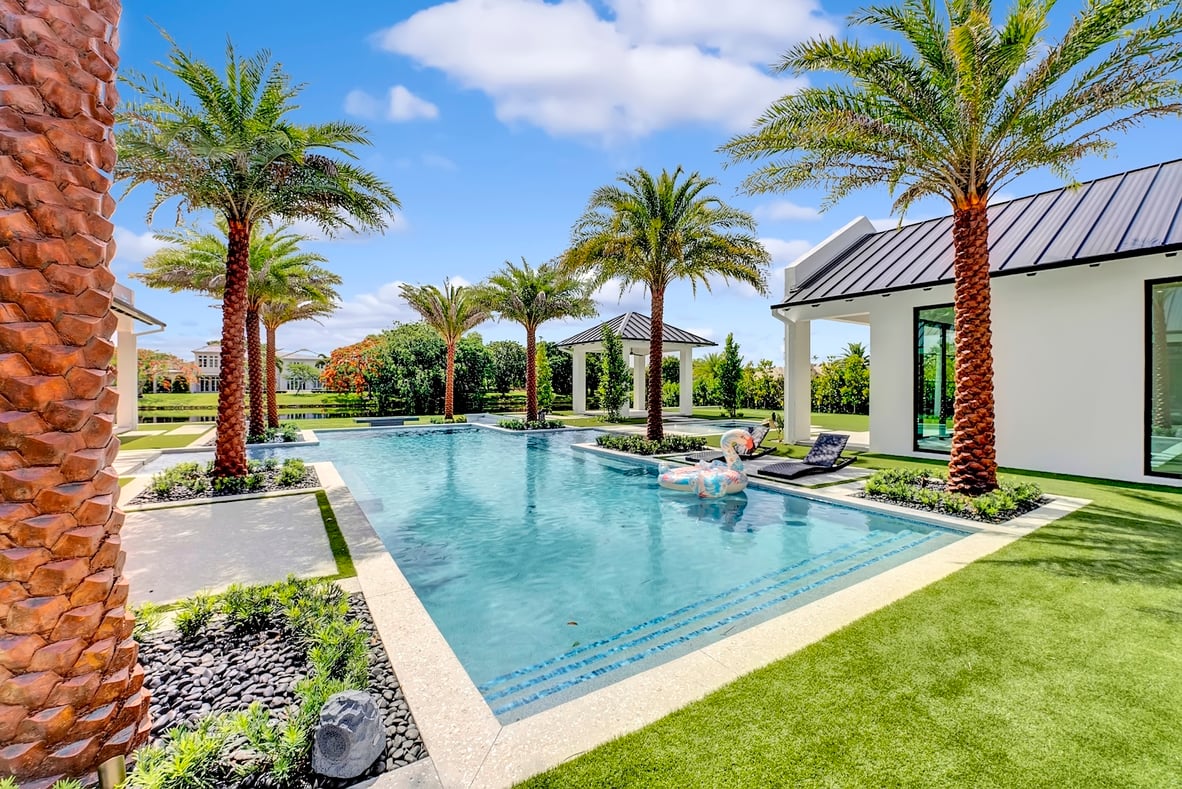
You've seen one. At a resort in the Keys, in a listing photo, or right over your neighbor's fence. An infinity pool doesn't look like a backyard feature. It looks like the edge of the world meeting open sky, and once you've seen it, a standard pool starts to feel ordinary.
So what does it actually cost to build one in South Florida? And is it within reach? This guide breaks down the real numbers, explains what drives the premium, and gives you an honest picture of what infinity pool ownership looks like in this market.
What Is an Infinity Pool?
An infinity pool (also called a vanishing edge pool, negative edge pool, or zero-edge pool) is a swimming pool designed so that one or more sides appear to disappear into the horizon. Water flows continuously over a lowered edge into a hidden catch basin below, then gets recirculated back into the main pool. The effect is the seamless visual merge of water and landscape that makes these pools unmistakable.
The terms infinity pool, vanishing edge pool, negative edge pool, and zero-edge pool all describe the same design. They are interchangeable. The engineering underneath is identical regardless of what the contractor calls it.
For South Florida properties, custom gunite construction is the right material for a true infinity edge. Gunite is poured-in-place concrete reinforced with steel rebar, which means it can be shaped to any geometry and structurally engineered to handle the precision leveling an infinity edge requires.
How Much Does an Infinity Pool Cost in South Florida?
Custom gunite pools at Fountain Blue start at $39,800. Infinity edge pools typically start at $80,000, with most projects landing between $100,000 and $130,000 depending on size, site conditions, edge configuration, and finish selections. Spas, premium tile, and elevated grades push costs higher.
Those are general industry figures. South Florida projects vary based on Palm Beach County permit costs, HOA requirements, and the engineering complexity that local soil conditions can add. A free consultation is the fastest way to get a number built around your specific property.
Fountain Blue walks you through the pool financing process from application to approval. 100% financing is available through Viking Capital, with a free consultation, no credit impact to apply, and terms up to 20 years.
What Makes an Infinity Pool More Expensive to Build?
The premium isn't arbitrary. Three structural components that a standard pool doesn't require account for most of it.
The Catch Basin
A standard pool holds water. An infinity pool continuously loses water over its edge on purpose and catches it. The catch basin (also called a balance tank or surge tank) is a secondary reservoir built below and behind the vanishing edge wall that collects the overflow. It has to be sized correctly for the pool's volume, waterproofed independently, and integrated into the circulation system. That's an entirely separate structure, engineered and built alongside the main pool.
The Secondary Pump System
Water that flows into the catch basin has to get back into the pool. That requires a secondary pump and filtration loop, separate from the main pool's circulation system, that runs continuously. Florida Building Code requires variable-speed pumps on all new residential pool installations, so both the primary and secondary systems will include energy-efficient variable-speed equipment. That's two complete pump systems where a standard pool has one.
Engineering and Site Requirements
An infinity edge only works if the overflow wall is perfectly level, within a fraction of an inch across its entire length. Achieving that in South Florida's variable soil conditions (sand, clay, and limestone are all common across Palm Beach and Martin County) requires precise engineering and careful site preparation. Sloped lots, elevated grades, and waterfront properties add complexity that affects both design time and construction cost.
The combination of these three factors is where the infinity premium comes from.
How Much More Does an Infinity Pool Cost Than a Regular Pool?
Infinity edge pools typically start around $40,000 to $50,000 more than a comparable standard gunite pool of the same size. The premium covers the catch basin, secondary circulation system, and the additional engineering and labor the vanishing edge design requires. Larger pools, multi-edge configurations, and premium finishes push that figure higher.
Infinity Pool Maintenance Costs in Florida
South Florida is one of the best places in the country to own a pool. Twelve months of swimming weather will do that. It also creates a maintenance picture worth understanding before you build.
Evaporation is the biggest ongoing variable for infinity pools. The open edge design exposes more water surface to South Florida's heat and humidity, which accelerates water loss compared to a standard pool. You'll top off the water more frequently, which means more chemical balancing to keep levels consistent.
The secondary pump system requires its own maintenance schedule, including filter cleaning, equipment checks, and occasional pump service, on top of the standard pool equipment. It's not complicated, but it's a second mechanical system with its own lifespan.
For properties near the coast, salt air exposure affects pool equipment over time. Stainless steel fittings, corrosion-resistant pump housings, and appropriate finish selections are worth the investment upfront.
Weekly professional service handles all of this. Fountain Blue's Intellitech Pro program covers chemistry, equipment checks, and cleaning for around $145 every four weeks. If you want to know what ongoing pool maintenance costs look like across different pool types, that breakdown is worth reading before you build.
Is an Infinity Pool Worth It in South Florida?
For the right property, yes. And South Florida is genuinely one of the best markets in the country for this investment.
A few conditions where an infinity pool makes the most sense: you have a view worth framing (water, golf course, preserve, or elevated grade), you're building at a price point where the premium represents a modest percentage of the total project, and you plan to stay in the home long enough to enjoy both the pool and any value it adds.
Custom gunite pools are built to last a lifetime with proper care, and the infinity edge is a design feature that ages well. There's no version of this pool that looks dated in 10 years. In a South Florida market where outdoor living is a year-round reality, a well-designed infinity pool isn't a luxury amenity. It's the centerpiece of the property.
Per Florida Statute 515, every residential pool requires a compliant safety barrier, minimum 4 feet tall with self-closing, self-latching gates. That requirement applies to infinity pools and is handled as part of the standard permitting and construction process. Source: Florida Statute 515.29
How to Finance an Infinity Pool
100% financing is available through Viking Capital, Fountain Blue's financing partner. You can apply for a free consultation without affecting your credit score, with loan amounts up to $250,000 and terms up to 20 years.
Infinity pools are a significant investment, and most homeowners don't pay cash. Viking Capital's program is designed for exactly this kind of project. See how pool financing works and what to bring to your first consultation.
Frequently Asked Questions
Do infinity pools waste more water?
More than a standard pool, yes. The open overflow edge increases evaporation, and some water loss through the catch basin system is normal. In South Florida's climate, expect to top off the pool more frequently than you would with a standard design. A properly sized catch basin and calibrated pump system minimizes unnecessary loss.
Are infinity pools harder to maintain?
Slightly. The secondary pump system requires its own maintenance alongside the main pool equipment. Weekly professional service handles both. The difference in effort for the homeowner is minimal, but the difference in service costs is worth factoring into your budget.
What's the difference between an infinity pool and a vanishing edge pool?
Nothing. Infinity pool, vanishing edge pool, negative edge pool, and zero-edge pool all describe the same design: a pool where water flows continuously over a lowered edge into a catch basin, creating the visual effect of water extending to the horizon. The terms are used interchangeably.
Do I need a special permit for an infinity pool in Florida?
You need the same building permit required for any inground pool in Florida. There is no separate infinity pool permit category. The permit process covers structural plans, plumbing, electrical, and the safety barrier requirement. Palm Beach County has specific documentation requirements including a signed affidavit and, in some cases, a recorded Pool Barrier Agreement. Fountain Blue handles the permitting process on your behalf. If you want to understand how the Florida pool permit process works before your first consultation, that's a good place to start.
How long does it take to build an infinity pool?
The same timeline applies as any custom gunite pool: 6 to 8 months from contract signing to your first swim. The additional engineering for the vanishing edge and catch basin is built into the design and permitting phase and doesn't extend the overall build timeline significantly.
Ready to Build Yours?
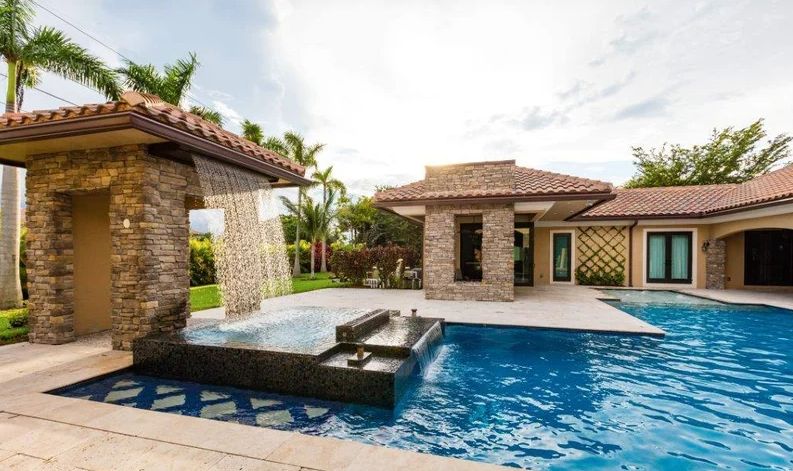
Fountain Blue Pools has been designing and building custom gunite pools across Palm Beach and Martin County for over 30 years. If an infinity pool is what you have in mind, we'll tell you exactly what it costs for your property, what the process looks like, and what you can expect from the day you sign to the day you swim.
Schedule your free consultation and financing through Viking Capital is available at the same time if you want to explore your options.
.jpg)